

High Impact Leadership During Change and Transition

As 2022 is coming to an end, I’ve been reflecting on the many shifts I’ve had the last few years – both professionally and personally. As a leader, one of your greatest challenges will be to successfully manage transitions. Simply said, transitions are the human side of change – the psychological reorientation of change. Transitions are how we effectively learn to let go of the past, accept the present, and focus on the future. Leaders most often focus primarily on the change itself, without giving enough thought to the the psychological side of the change (the human condition). In our experience working inside organizations managing change and transition, it’s the transition, and not the change itself, that most people resist.

In general, we have difficulty letting go of the past and the way things used to be. It’s saying goodbye to the way things used to be and what has been lost. We all show up differently this way. Also, our brains dislike uncertainty. We saw this during the Pandemic. Often, employees will complain about the way things used to be or the changes in place for months or even years to come. This can prevent people from moving forward. We see this when we work with organizations on acquisition integrations. We want our leaders to learn how to ensure psychological safety in their teams which ultimately reduces anxiety, chaos, and frustration. This way employees can best move through the transition which leads to credibility and trust.

In 2020, we adapted this model based on William Bridges Model “Managing Transitions”:

Bridges says that transitions begin with an ending.

The first phase is when “people identify what they are losing and learn how to manage these losses.” according to Bridges. Recently, after I experienced my own loss, I revisited this model. I realized it isn’t a linear process. At times I felt I was in the Neutral Zone nearing my New Beginning, yet suddenly I would feel anger and denial again – cycling back to the Endings Zone. I started to see this model in more of a cycle so we created this new model:
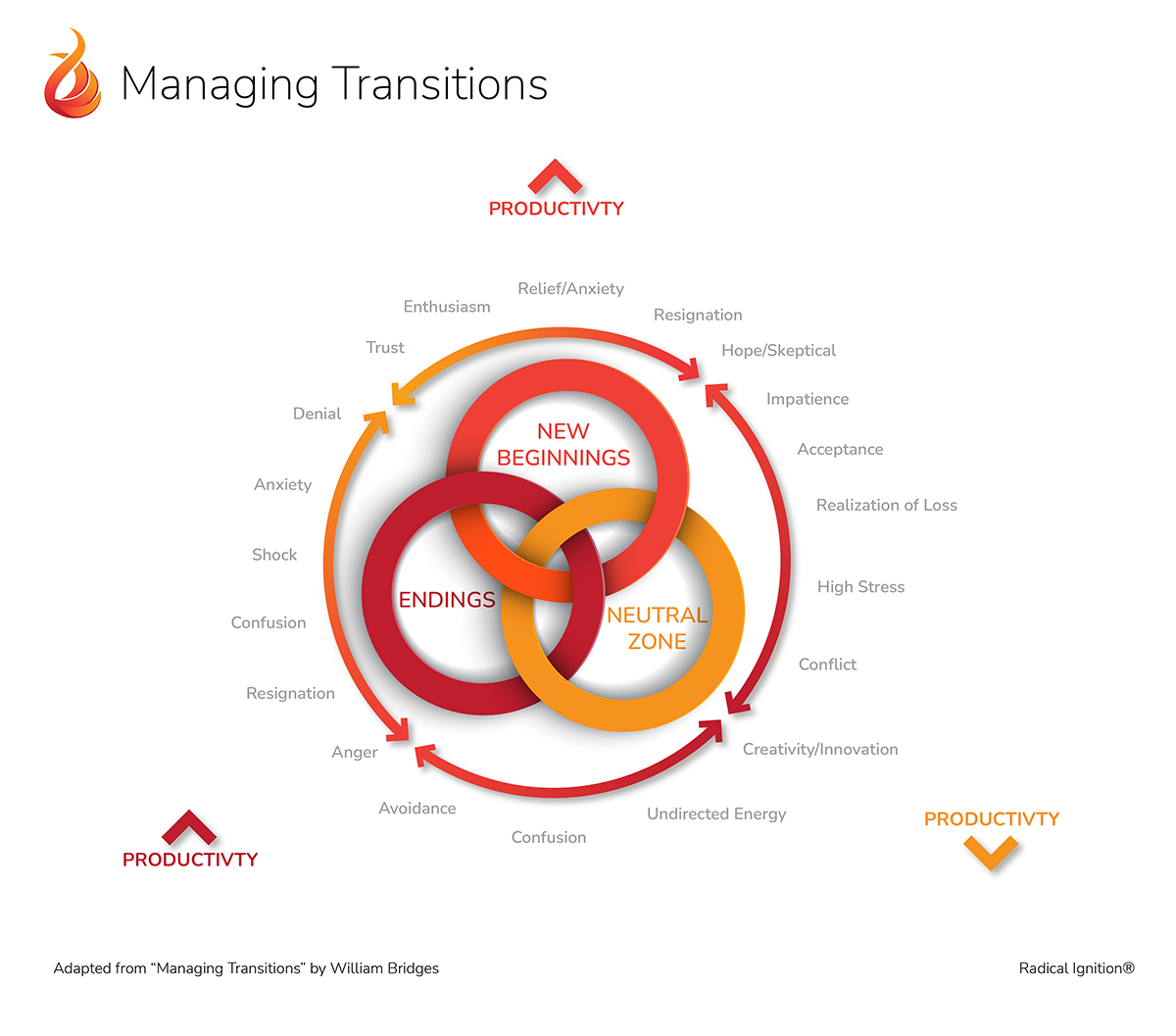
There are different levels of productivity in each zone. When I realized I was in transition again, I was sad and almost depressed for weeks. At first, I was shocked at what had happened in my life. Then I wanted to reject it – but couldn’t. Next, I got angry. When the anger phase hit, it was sort of a relief, because I felt extremely productive. When things are ending, this is often what is happening. We have a hard time letting go, we are in denial, and we might feel angry. We might have a new sense of energy.

Bridges says, “The Neutral Zone is the very core of the transition process. This is the time between the old reality and sense of identity and the new one. People are creating new processes and learning what their new roles will be. They are in flux and may feel confusion and distress.”

The neutral zone is the seedbed for new beginnings.

We see the Neutral Zone as the “messy middle”. It’s also where creativity and innovation can happen. If you look back to 2020, when companies were pivoting and creating new business models – they were in the “messy middle”. Productivity was low and many were not producing a lot of revenue. However, it was an amazing time of innovation, and many organizations were able to create new products and shift their strategies.

One of the first things you can do as a leader is to plot yourself on the model and ask yourself what you might be feeling. Secondly, make sure to practice self-care.  Next, check in with everyone on your team. Remember that everyone shows up differently, and more than likely, everyone will be in a different place. We all handle change in different ways.  Lastly, show people you care by validating how they feel. The more curious you can be, the better. After we’ve checked in with everyone on the team, the next challenge is to help pull them along the cycle ultimately getting them to a New Beginning state and to learn to trust again. It comes with a tremendous about of relief and maybe a little anxiety for most people.

Whether it’s a change at work or at home, transitions can be impactful and come with many emotions.  The more you are aware about your own feelings during transition along with your teams, the more you can show you care ultimately leading them around the cycle to trust.
Melanie VargasMelanie is the Chief People Officer of HaptX, Inc and Founder & CEO of Radical Ignition, Inc.  In her 25-year career, Melanie has developed a passion for unleashing human potential and creating pathways for people to be their best. Melanie’s successful track record having worked across hundreds of technology organizations in her consulting career gives her a great perspective as a speaker, facilitator, leadership coach and HR leader.

Feeling stuck? How to push through the Doldrums and recognize the gift of changing seasons

Fall in the Pacific Northwest is absolutely stunning. When I moved here from Texas 25 years ago, I fell in love with this time of year. When the leaves start to turn each year, I am reminded of the many gifts of change and transition. I am also reminded of endings and new beginnings – the change of the seasons in our lives. With the fall each leaf, I know that something beautiful is on the other side.

Gallup recently released a study that says, “quiet quitters make up at least 50% of the workforce”. I’m fascinated by the idea of quiet quitting. I will often hear from someone because they “feel stuck” and they want to engage a coach to help them. They’ve suddenly lost their motivation, they lack confidence, they have zero energy, they lack in self-care, they feel resentful and sometimes even angry. They don’t know where to start. They feel trapped. They lack direction.

This, my friends, is the:

The Doldrums

No alt text provided for this image

I wonder how many quiet quitters are in the Doldrums? I learned about this life chapter, “The “Doldrums” and the “Cycle of Renewal” when I was going through my executive coach training at the Hudson Institute of Santa Barbara. At the time, I was in the Doldrums. I couldn’t understand what was wrong with me. I was feeling my inner critic and imposter syndrome stronger than I had in years. I lacked confidence. I could not make any decisions. I felt stuck. I’ve learned that you can be happy and fulfilled in one area of your life (i.e., your personal life), and in the Doldrums in your professional life – or the other way around. It felt so validating to finally have a description for how I was feeling. Once I was able to put a label on it, I felt so relieved. I knew in an instant, I had to do something about it.

In The Adult Years, Fredrick Hudson defines the Doldrums as “I. a state of inactivity or stagnation; 2. a dull, listless depressed mood; low spirits.”  He further states, “Out of your own success have come forces that are now working against you, and you begin to question whether the “success and happiness” that you have achieved are lasting friends. Instead of enjoying your plateau as the success you deserve, you feel like you are treading water to avoid drowning…The problem is, most people would rather remain stuck in a familiar world that is declining in enchantment than risk moving ahead into unknown conditions to find a new life challenge.”   I can confirm that in my own situation, I stayed in the Doldrums far too long, and we see this inside the organizations we work in as well. People can stay stuck for months and even years.

Now to unpack some of this and help offer some simple tips on how to push past the Doldrums. Guess what? You don’t have to remain there long!

Do what’s uncomfortable and discover what’s possible.

-Susan Mann


Once you see something, it’s hard to unsee it. If you are willing to explore it, you can see the possibilities. One of the best things to do here is to actually do something! Fredrick Hudson has some great suggestions for managing the Doldrums in his book, such as “taking evening courses, seeking therapy, take up new hobbies, or join a professional organization.”

Here are my top three recommendations:

  1. Make a list of your gifts and talents that bring you joy and energy – and ignore the ones that drain you. This was pivotal work that I completed with my coach, Susan Mann, when I was going through my coach training.
  2. Identify your core values and passions.  Your values will anchor you and guide you, particularly during difficult times and times of change. Taking the time to get clarity on these will help you.
  3. Create generative space for yourself right now in your life.  Focus on self care and setting boundaries. It could be boundaries need to start with yourself first. It could be a simple commitment to start and stop times in your day. It could be a mindfulness practice throughout your workday to keep yourself present in the moment.

Sometimes amazing change can happen right where you are. It doesn’t require divorce, quitting your job, or even a sabbatical. Minor tweaks can make a significant differences in your life to help push you through the Doldrums. Self-searching and reflection are the best way to find your inspired future. It’s also helpful to hire a coach – someone who specializes in transitional coaching. Thanks to the amazing coaching I received, after a period of time spent in “cocooning”, amazing and creative energy started to bubble up in “getting ready”, which led to my own amazing transition to launching Radical Ignition. Amazing things ignite when you can create generative space.

Recognizing the gifts of changing seasons in our lives requires acceptance of endings as we move to new beginnings. Something new can’t happen if we can’t welcome and accept the beauty of the end. I often wonder if one of the key reasons we stay stuck is fear of the uncertain. And yet, how will we ever know what a new beginning will look like if we don’t honor the end?  Hudson writes: “Endings are symbolically the acceptance of death as reality, yet most of us spend our lifetimes denying the many little deaths that we experience in the form of losses. Our endings, more than our beginnings, keep us committed to living as fully as we can. Letting go of what is not working in your life creates the opportunities for making improvements and new beginnings.”


Melanie is a frequently requested speaker on resilience and the Founder & CEO of Radical Ignition, Inc., an executive coaching and training firm. 

In her 30-year career, Melanie has developed a passion for unleashing human potential and creating pathways for people to be their best. Melanie’s successful track record having worked across hundreds of technology organizations in her consulting career gives her a great perspective as a speaker, facilitator, leadership coach and consultant. 

If you are interested in our workshops or coaching, please reach out at info@radicaligniton.com.

Chat bubble icon

Radical Values Exercise

Coaching Tool
Our values can serve as an anchor and source of strength when you are aware of them especially during times of change. Use our tool to discover your core values.

Coaching icon

How I Want to be Coached

Leadership Coaching Tool
Clarify your needs and expectations with direct reports! The more clarity and alignment you have within your working relationships, the better your chances for a productive and enjoyable experience that flourishes.

This field is for validation purposes and should be left unchanged.