The Cycle of Resilience

I am a person who has experienced a lot of adversity in my life. Each time I’ve hit a wall in my own resilience journey, I find a new way to pull through. There have been times in my life when I have tried to stand strong, only finding myself more exhausted and realized in the end standing strong had actually made it worse.

Claire Breeze, Award-winning corporate coach and Buddhist, beautifully and perfectly describes this as the difference between resilience and endurance. Claire describes,

In her article, Resilience not Endurance, she writes, “It feels good to have endurance, but it can become the goal in itself. If resilience is lively, challenging, bouncy and full of flexibility; endurance is characterized by stiffness, survival, cutting off from oneself to get through it.” I’ve learned that being strong and sturdy is not the key to resilience.  I now understand that all the years of marathon running, pushing myself to limits hasn’t served me during hard times. I can’t just push myself through resilience, no matter how strong I am.

“Endurance is the near enemy of resilience”


I have been asked many times to define resilience. Resilience isn’t about strength. I see it as our ability to recover from difficult experiences and setbacks, to adapt/flex, and move forward and sometimes even experience growth as a result of the hardship. The flexibility part is the most essential piece. Acceptance is a big part of resilience. If we are to move forward, we must stay in acceptance, open, willing to learn, fluid, flexible, adaptable, curious, and willing to try new things. It also requires us to see failure as an opportunity to grow and learn. We can’t stay stuck. What is great is it can be learned developed and honed. If this is a muscle that isn’t very strong for you, you can work on it to build it over time.

In my own life, when I began to move with the challenge and view it as temporary blip, it made it more bearable. I realized it was my mind that was the problem – negative thinking holding me back every time.

I’m reminded of this beautiful Haiku written by Mizuta Masahide, a 17th century Japanese poet. I now have evidence based on the hardships I have experienced in my life that there are gifts in every challenge. I have this perspective when I am hit with a new hardship. If I absolutely belief everything turns into a gift and opportunity, there is nothing to worry about.

It gives me the confidence that everything is going to be ok – I’ve got this. I may not see the gift at the time, but I know it is coming.

“Barn’s Burnt Down…Now I can see the Moon”


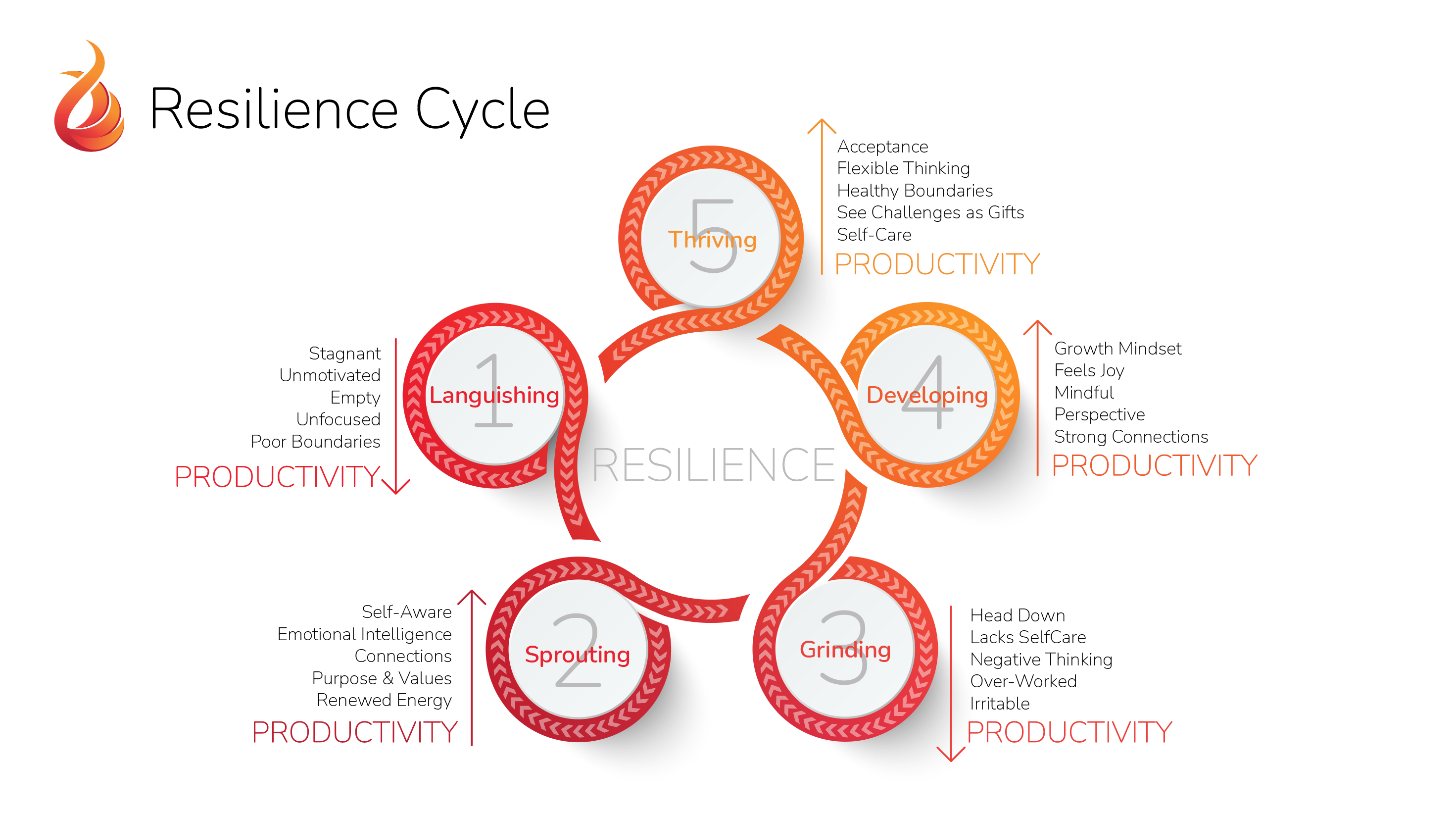
I began to see resilience as a cycle.
Stage 1

While at times I have felt my resilience muscle was very strong, there have been times, I felt it was weak. When I was at my lowest point, I felt no motivation and was empty on the inside. In his Ted Talk, Adam Grant, a Wharton psychologist, describes this feeling as “languishing”. I am not productive at this stage and not feeling engaged in anything I’m doing.  In Adam Grant’s New York Times article, he describes it as “It wasn’t burnout — we still had energy. It wasn’t depression — we didn’t feel hopeless. We just felt somewhat joyless and aimless.”

Stage 2

Self-awareness and emotional intelligence is an important element of this stage. Keeping strong connections (i.e. community) is very important in resilience building, and essential at this stage. Thankfully, I’ve always believed in strong connections with friends, family, and colleagues. These relationships help to reconnect me to my purpose and values. After revisiting my values, I began to feel a new sense of renewed energy. I refer to this stage as the “Sprouting”.  I feel better and I’m starting to bounce back.

Stage 3

I suddenly realize there is work to be done. I’ve been so busy building community and being self-aware, that I haven’t been getting things done. It’s time to buck up and get to work! I call this the “Grinding” stage. There is a focus on endurance at this stage. At this stage, I feel like I’m super productive.  I’m stuffing down whatever the hardship is so I can focus on the work at hand. I might be back to standing strong again. I’m working long hours. I feel like I’m achieving things. I’m not taking care of myself at this stage and I’m letting healthy boundaries slip. I’ve got back-to-back zoom calls all day long not leaving any room for myself to breathe. By the end of the day, I am irritable, and my family hardly wants to be around me. The next day, I start all over again. This is when I let those old negative beliefs slip in.

Here are some of my tips on how to manage your inner critic at this stage:

  • “If you don’t say yes to next client/project/whatever it is, what if there won’t be another one?” (i.e. There isn’t enough) – Instead, reframe this to “there is enough”.
  • “How could you make a mistake like that? What is wrong with you? You just need to work harder and longer” (i.e. I’m not good enough/I’m not worthy) – Instead, reframe this to “I am enough”.

I usually hit a wall at this stage. I call this a “Resilience Rut”

Stage 4

Because I built a foundation of self-awareness and emotional intelligence, I suddenly remember stage two and gain some perspective, and I enter the “Developing” stage. At this point I recognize some growth.  I start to lean into my community and rebuild connections for I lost touch a little bit at Stage 3. I’ve reinvested in some self care and healthy boundaries ensuring that I’m not spreading myself too thin and I’m saying yes to the right things. I’m back on track, and I remember how good it feels. At this stage, it’s important to practice solitude. It’s also important to invest in mindfulness practices. A few simple steps, and I begin to feel real joy. I feel myself moving through the change again. I start to see things more clearly. At this point, I’m starting to see the gifts in whatever I am going through. I feel lighter.

Stage 5

Suddenly I feel I am flourishing – the “Thriving” stage. This is the most resilient stage of the cycle. When I am here, there is nothing that can get in my way. I’ve accepted the hardship at this stage. I’m focusing on the things I can change versus the things I cannot. I’m adaptable, positive, productive, and can set healthy boundaries for myself. I see a silver lining in what has been happening. In the past, there has never been a challenge in my life, where there hasn’t been a gift. I need to lean into this and trust it. If I believe there is a gift in every challenge, there is no reason to fear whatever challenge is presented. I’m no longer worrying about the future and regretting the past, but simply appreciating the present moment. This is true acceptance. This stage is not about strength – it is about acceptance and gratitude.

Melanie is a frequently requested speaker on resilience, executive coach and the Founder & CEO of Radical Ignition, Inc., an executive coaching and training firm. With over two decades of C-level Human Resources experience working in technology organizations, Melanie zeroed in on her superpower of helping leaders and teams reach their full potential through a results-oriented approach. She focuses on thought partnership, transformation, change and creating action plans with her clients. Whether navigating strategic decisions, building executive presence, fostering team alignment, or enhancing interpersonal effectiveness, she is committed to guiding leaders on their journey to extraordinary success. She guides leaders to increase their awareness, discover their blind spots, and cultivate resilience to create lasting impact.

If you are interested in our workshops or coaching, please reach out at info@radicaligniton.com.


Leadership and Lattes – Change and Resilience

Join us in listening to Melanie’s interview on the Leadership and Lattes podcast where she had the opportunity talk about change and resilience – her two favorite topics! It’s always in the messy middle when we can find ourselves in a creative and innovative space.  Thank you to Kristal Roberts, Tricia Rhine, MSSL, ACC and Danielle Lord for inviting us to join this wonderful discussion!

https://podcasts.apple.com/us/podcast/innovation-in-the-midst-of-transition-with-melanie-vargas/id1508904890?i=1000530618058

Resiliency Theory Podcast

This was such a great podcast interview with the amazing Ashley Carlson, where I had the opportunity to to discuss one of the theories she is trying to prove. Is there a resiliency quotient? Also, is there a values equation? Can resilience be learned or taught?

Because I am both passionate and fascinated about these topics, we had a lovely discussion. I was able to weave in work with my clients, as well as my own personal values around balance, belonging, growth, family-orientation, and fun!

You can listen to Episode 17: Welcome Melanie Vargas.


Leading in a Traumatized World

There is light at the end of the tunnel. We have a vaccine, kids are returning to school, and we are discussing strategies of how to adapt moving forward. Yet employees are more stressed and burned out than ever. Shouldn’t they be happy and hopeful for the future? Shouldn’t they be productive, grateful, and engaged?

Burnout and Stress

I’ve been hearing from clients, friends, and family that they are feeling wiped out.  Almost every organization I am working with tells me that their employees are experiencing burnout —  a state of emotional, physical, and mental exhaustion caused by prolonged stress. Burnout occurs when you feel overwhelmed, emotionally drained, and unable to meet constant demands.

I started thinking about this deeply. Mental health experts have been worrying about the effects the pandemic has had and will continue to have on our society as a whole. Many are facing  anxiety, depression and even post-traumatic stress disorder (PTSD).  As defined by the Mayo Clinic, PTSD is a mental health condition that’s triggered by a terrifying event, where one has either experienced or witnessed it.  Symptoms may include flashbacks, nightmares, and severe anxiety, as well as uncontrollable thoughts about the event. This may feel familiar to you.

As a society, we have been bombarded with constant change, life-threatening illness, isolation from friends and the things we love, fear for the safety our family and friends near or far, an unpredictable political environment, elevated social justice issues, ceaseless uncertainty, disruption of our normal routines — and more! For the last year, we have lived our lives in perpetual uncertainty and change. Even those who adapt to change well are not coping well.

We are seeing this impact in our employees and within our organizations. We are seeing more employees are stressed, perhaps at a level not seen in the workplace before. Many are trying to balance work-from-home schedules while managing kids in virtual or hybrid school. They are dealing with constant disruptions to their workdays— whether kids, dogs, or doorbells. For those working from home, with no commute time, they are working longer days than before. Employers are struggling to understand the needs of their employees. Leaders are struggling with how to motivate and engage their teams.

Stress and Neuroscience

Stored memories in your hippocampus remind you that your mom is turning 80 this year and has heart issues. You haven’t seen her in over a year because she lives on the East Coast, and you don’t feel safe to travel yet.  You know she hasn’t gotten her vaccine yet and you are worried, because she hasn’t been feeling well lately. This lights up your amygdala, which is the fear center of your brain. This activates your hypothalamus. The hypothalamus then sends a signal to your pituitary glands, which next sends a message to your adrenal glands, releasing cortisol throughout your bloodstream. Cortisol is the primary stress hormone, which prepares your body for fight or flight. But you can’t run away from or fight your mind. So what should you do?  You start to panic. Anxiety starts to kick in. It’s as if you are seeing a bear, but there is no bear in sight.

The reptilian brain, which we refer to as our “lizard brain” activates a fear response in your limbic system, releasing cortisol throughout your body. This bodily reaction is what gets you out of immediate or potential danger. Unfortunately, the danger is completely inside your head. You can neither fight or run.

However, at the same time, the rational part of your brain, the cortex, appraises the situation carefully. You begin to realize that maybe it’s not all doom and gloom. Maybe she simply has a cold. Her heart issue has been under control for quite some time. Could it be that she isn’t as high risk as you originally thought? When this happens, your cortex deactivates the amygdala, which inhibits the secretion of cortisol via the hypothalamus. Thus, bringing you back into homeostasis and reducing the anxiety in your body, bringing you back to a relaxed state.

Women at Work

Women in the workplace are struggling more now than ever. Senior-level executives who are balancing motherhood are being forced to consider downshifting their careers or leaving the workforce.  In Fortune’s 2020 article, “Will working women recover in 2021?”, Melinda Gates shares her opinion, “A big reason is caregiving.  Even before the pandemic, women were nearly three times as likely as men to quit their jobs to take care of a family member”. They are leaving the workforce in record numbers.  The 2020 McKinsey & Company study,  Women at Work found that one in four women is considering downshifting or quitting because of increased caregiving responsibilities during the pandemic.

What CAN you do?

With hope of a widespread vaccination in the near future, the expectation is that we’ll return to normal. Shouldn’t our employees recover? The truth is, once we remove this collective blanket, some of us will not recover as easy as others. We have been living in a world of trauma for more than a year now, and leaders cannot expect their people to return to normal at the drop of a hat. Some will take longer than others.

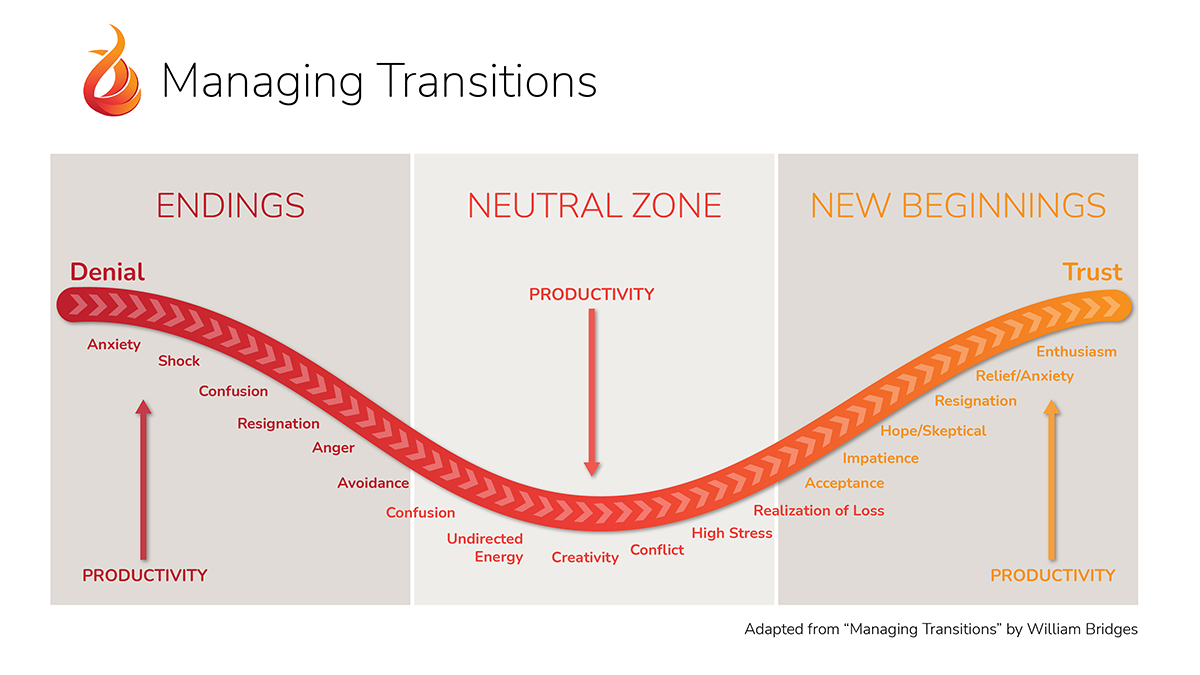
We all recover at different stages. I like William Bridges model to explain how people handle the psychological components of change through transition. There are three stages in his model: Endings, The Neutral Zone and New Beginnings. This first stage begins when you identify with what you are losing and learn how to manage the losses.

Many of my clients are in the second stage right now, the Neutral Zone, which occurs after letting go. It is the core of the transition process. Bridges explains this as the time between the old reality, sense of identity and the new reality. People are creating new processes and learning what their new roles will be. They are in flux and may feel confusion and distress.

I’ve adapted Bridges model to indicate how we all move through transitions at different stages. It also illustrates where productivity is higher and lower based on certain zones.

If leaders can coach, manage, and communicate effectively in in the neutral zone, there can also be a tremendous amount of creativity and innovation at this stage.  


Bridges says, “The neutral zone is the seedbed for new beginnings.”  I see this as the messy in the middle area, but also the creativity stage if we lead well.  It is important that leaders develop strategies to help move their people through these zones towards building trust, which also yields higher productivity.

The following are five strategies that can equip your leaders to help manage their teams through these turbulent times.

Empathy-based leadership

We need emotionally intelligent leaders who are capable of bringing vulnerability, empathy, and feelings into the workplace. Empathetic leaders are able to experience a situation the same way another person experiences it. Demonstrating empathy is a key competent of leading others. It builds trust and leads to a deeper understanding of another’s situation. It also creates psychological safety within the organization, which is essential to engagement practices right now. A person who exhibits empathy is able to effectively deal with difficult issues and create solutions that many people can support. Right now is the most important time to assess your own level of empathy. If this is a weak point for you, work with a coach or someone who can help you flex this muscle.

Stress management strategies

Stress management strategies help your employees develop the resilience needed to survive these turbulent times. Resilience is the ability to bounce back after a difficult or stressful event. Employees need help developing both proactive and reactive strategies for managing stress. Building resilience is an excellent proactive strategy in dealing with stress.  Adding things like exercise, healthy eating, and mindfulness are great examples of items you can add to your resilience toolkit. Employees also need to develop reactive coping strategies when dealing with stressful situations that are happening in the moment.  Examples of reactive coping strategies are taking a break, deep breathing exercises, and utilizing relaxation techniques.

Meet people where they are

This is situational leadership 101. Not everyone is stressed by the same stuff. We all respond differently to stressors. You can’t make assumptions, especially on teams and with the people you manage. You may not see your team or direct reports every day, but you should be checking in with them every week to understand their needs (both at work and at home). Make sure you are asking the right questions about their stress levels and what is happening for them at home and at work. This is where your empathy dials in.

Continue flexible schedules

Remote working and flexible schedules are no longer temporary perks. They are requirements for an organization that wants to attract and retain employees. We need understanding leaders and flexible organizations that can adapt to the needs of their employees. Working parents need employers to recognize their struggles. Providing flexible schedules will allow employees needed balance and de-stressors in their day, for example to take walks or attend a yoga class.

Model the way

As a leader, check in on your own stress. It is important that you take care of yourself. How you lead through change and manage your own level of stress will impact your team. This is an important time to display strong leadership. It’s a time for self-care, checking in on your own level of burnout, and advocating for your needs – at work and at home.  You can’t take care of your team if you aren’t taking care of yourself.

When leaders make these investments in their people, it creates emotionally productive employees with higher levels of phycological safety in the organization. When employees are less stressed, their productivity and engagement go up.


If you are interested in our Emotional Productivity for Leaders training, or would like to engage us to speak on one of these topics, contact us at info@radicalignition.com. Melanie is the Founder & CEO of Radical Ignition, Inc.  In her 25-year career, Melanie has developed a passion for unleashing human potential and creating pathways for people to be their best. Melanie’s successful track record having worked across hundreds of technology organizations in her consulting career gives her a great perspective as a facilitator, leadership coach and consultant.  She has worked with leaders at all levels, tenured CEOs, founders, and first time CEOs.


Changing Behavior from a Coach’s Perspective

I’ve recently been thinking about neural pathways and our resistance to changing behavior. The other day while having a chat with a friend about the habit of wearing masks, she remarked it was odd that it took so long for us to get used to it. But is it really? You may remember in the first few months of the Pandemic, we struggled with masks, we resisted, we hated the way they fit our faces, and it was hard to remember to wear them. Twelve months out, most of us wear masks like it is just part of our regular routine, we grab them before we leave the car and seldom forget them. This led me to an interesting parallel in my work with my coaching clients and how changing behavior is so hard.

The Old 21-Day Habit

The classic 21-day habit theory came from Dr. Maxwell Maltx, a plastic surgeon practicing in the 1950’s. After noticing a pattern of patients exhibiting behavioral changes after 21 days, Dr. Maltx wrote a book investigating the phenomenon. He found that it would take a patient about 21 days to get used to seeing a new face or adjusting to an amputated arm or leg. Groundbreaking for its time, his book on the 21-day habit went viral.

In the intervening years behavioral science advanced scientists debunked the 21-day habit theory. In our present understanding of behavior, it’s thought that it takes between three to six months for a behavior to become habitual.

Our Brains and Our Behavior

In The Neuroscience of Behavior Change, Juli Hani describes how the neural pathways in our brains change:

“Neural pathways, comprised of neurons connected by dendrites, are created in the brain based on our habits and behaviors. The number of dendrites increases with the frequency a behavior is performed.”


Imagine for a moment that your brain is a road, and that your neural pathways are grooves in that road. The more we repeat a pattern, the deeper those grooves get, and the easier they become to follow. Some of us have very deep grooves, as we have been repeating these patterns for many, many years. Like on a road, it takes a tremendous amount of willingness and commitment to reshape those grooves, especially the deepest ones.

But one thing we have learned from decades of studying human behavior is that communication and repetition is the key to successfully forming, or breaking habits. As you continue to do a new thing, like wearing a mask, you will find that the behavior becomes automatic. With enough repetition, new grooves form as we create new neural pathways in our brains. With more willingness and commitment you can yield even more successful results.

Neuroplasticisty

Despite what you may have heard, the old adage “you can’t teach an old dog new tricks” does not apply to humans. There is hope for those of us that may be older and set in our ways. This hope is called neuroplasticity. Neuroplasticity is the brain’s ability to change itself constantly and consistently by forging new neural pathways and shedding those which are no longer used, which is essential in adult learning.

In Tara Swart’s article, “The 4 Underlying Principles Of Changing”, she writes that “keeping your brain plastic and flexible isn’t as easy as simply doing a daily sudoku or crossword. For the brain to rewire itself it requires sustained practice of a new behavior which will sufficiently challenge the brain to think in a new way.” It is important to focus on continued learning and development of new neural pathways.

Coach’s Perspective

As coaches, we see these struggles with our clients, whether they manifest on things like confidence, imposter syndrome, or building leadership capacity. We continue to provide strategies for overcoming barriers, creating action plans, accountability and support while our clients are working towards their goals. What I have seen in my work with my clients is the common traits of the ones that achieve the most success are willingness and commitment.  It is just like anything else – if we are willing and committed to going to the gym every day, we are going to get stronger. Once we find the willingness, and then we make the commitment to changing to changing behavior, we will create new neural pathways.

Melanie is the Founder & CEO of Radical Ignition, Inc. For over two decades, Melanie’s passion is unleashing human potential. She has spent her career creating pathways for people to be their best and is an experienced leadership coach, people consultant, and facilitator. When working with organizations, Melanie draws from her strong business background and over 20 years in senior leadership inside organizations working with executives and leaders at all levels, as well as her experience consulting across hundreds of organizations in her consulting career. If you are interested in executive coaching or leadership training, contact us at info@radicalignition.com.

Three Easy Steps to Shutting Down Your Inner Critic

Do you spend time questioning if you are really competent? Do you compare yourself to others feeling less than at times? Have you ever felt that you aren’t smart enough?

Join the club! This is something I have struggled with myself in the past as a woman in senior leadership roles. Over the years, I have developed some coaching tools and changing habits to help myself and my clients.

Many highly capable executives struggle with their inner critics and at the same time they also may suffer from Impostor Syndrome, which is a pervasive feeling of self-doubt, insecurity or fraudulence despite often overwhelming evidence to the contrary. Often times, we are highly capable, educated, experienced individuals, but on the inside, we question our worthiness. I have seen this effect both men and women. In times of stress, the inner critic can rear its ugly head, and it’s even harder to shut it down.

What I have learned about the inner critic through my work with my clients and understanding my own is often times we create a narrative that isn’t based on reality. In the book, Rising Strong, Dr. Brené Brown says storytelling helps us all impose order on chaos—including emotional chaos. When we feel pain, we create a narrative to help us make some sense of it. This story doesn’t have to be based on any real information.  What I have found is that when we peel back the layers of the issue, we can usually get to the root of the issue – where it all started. Often, it’s based on a story from many years ago, typically family origin-rooted.

Here are three easy steps to start changing habits in shutting down your inner critic:

STEP ONE: Get to know your Inner Critic!

Understand your triggers get to know your imposter syndrome. Make friends your imposter syndrome! When is this coming up for you? Is it right after a promotion? Are you busy comparing yourself to everyone? What is the narrative (the story you are telling yourself)? When did this start for you?

Get to the root of the issue. Peel back the layers and try to really understand when it all began for you. For me, it is rooted in family origin, as it is for many of my clients. For some, it starts later. Nonetheless, figuring this piece out is helpful in moving forward.

STEP TWO: Prove it wrong!

Literally jump into the court room and play defense attorney. Discredit it! Pull out your journal and provide yourselves with examples as such.  If your inner critic has been telling you that you aren’t good enough, provide some evidence as to why are good enough. If your inner critic is telling you that you can’t get the job, the promotion, the title change, whatever “IT” is, provide some evidence based on what you have accomplished in the past to prove it wrong.  You can also bring in reinforcements. Friends and family can be helpful allies with this process.

STEP THREE: Discover your key strengths and talents!

Dig into your key strengths. What have been your accomplishments? Think back to times in your life when you were the happiest and specifically what you were doing during that time that made you happy. Think back to your childhood, college, and previous work roles. Our natural talents bring us joy and instill an inner strength and confidence. If you still are not clear on your strengths and talents, do your own 360 and interview your current and past colleagues, friends and family members. Assessment tools like the Strengths Finder and the DISC can be a great way to help with this as well.

Melanie is the Founder & CEO of Radical Ignition, Inc. For over two decades, Melanie has spent her career creating pathways for people to be their best and is an experienced leadership coach, people consultant and facilitator. When working with organizations, Melanie draws from her strong business background and over 20 years in senior leadership inside organizations working with executives and leaders at all levels, as well as her experience consulting across hundreds of organizations in her consulting career. You can learn more about Radical Ignition at www.radicalignition.com and reach out at info@radicalignition.com.


My Personal Path to Resilience

I recently spoke at an event on “How to Thrive through Uncertainty and Change” with a couple of my esteemed Hudson coach collogues. It got me thinking about my own journey to resilience. I have experienced a lot of adversity in my life. After many years of struggles, I thankfully realized at the young age of 24 I had a problem with alcohol and found recovery. Shortly after, at age 25, I had to make the tough decision to have a child on my own. This was a difficult choice back in 1995 in Houston, TX, and came with a lot of judgement. I then left my family and moved across the country by myself with a 2-year-old, for a job opportunity and to give my son a better life.

For 20 years I kept a lot of this story a secret while carrying so much shame. I thought, “what will people think of me?” or “shouldn’t I just fit in”? Now happily married, two kids later, and age 51, I wear my 26 years of sobriety like a badge of honor. My now almost 26-year-old son is a Software Engineer at Apple. I never dreamed 20 years ago I would be sharing this story now and so publicly. I have never felt more pride in my story. It only took me 20 years to change the narrative.

Though I have experienced many challenges in my life, I have also experienced tremendous joy. I feel it has made me stronger, wiser, and more curious about the world. I have grown and I have loved deeply. I have had lots of setbacks, but I learned from them and then moved forward as a result. I recently learned through Dr. Brené Brown’s “Wholehearted Inventory” that my “Resilient Spirit” is a strength for me, so I thought I would share my top five Resilience Toolkit practices.

My Top Five Resilience Toolkit Practices:

1.    Define your Values

Our values serve as an anchor. When our actions are not aligned with our values, it doesn’t feel good. You might say, “this doesn’t feel right”, which is an indicator that your actions don’t reflect a core value. This is something for you to really pay attention to. Your values can be a source of strength when you are aware of them especially during times of change. This is extremely important right now during the Pandemic when we have so much change hitting us at once. Right now, we need to hang on to who we are and let this guide us in our decision making. I work with my clients on a values exercise that helps them to identify their core values.

Over the years, I have led many entrepreneurial organizations to help identify their organizational values, which should drive everything they do in their business (customer service, HR, sales, etc). I have seen the ones who did not fare well when their values were not at the forefront. Much like in business, your personal core values should drive everything you do.

2.    Be Vulnerable

Something magical happens when we are willing to be vulnerable. It allows everyone around us to open up. It tears down the walls and lets us see our blind spots and patterns that maybe we didn’t see before. I shared a little bit of my own vulnerability with you. Maybe this will help you share some of yours. When we share, we heal, and we start to move forward. Be willing to put yourself out there.

3.    Develop a Mindfulness Practice

I first learned about Mindfulness in a group DBT (Dialectical Behavior Therapy) for my teenage daughter when we attended a group DBT class to help her treat her anxiety disorder. I had no idea how useful it would be for me! What a gift mindfulness is and it doesn’t take a lot of time. Not everyone feels they can meditate, but everyone can practice mindfulness. I practice mindfulness when I am out on my runs or out for a walk.

I integrate it in the middle of my workday. It is something I help my clients develop in their Resilience Toolkits as well. Sometimes, simply taking a few minutes for deep breathing, paced breathing, taking the time to focus on the beauty in the world (trees, leaves, earth) is enough to take away some of the anxiety and get you grounded and present.

4.    Have Goals

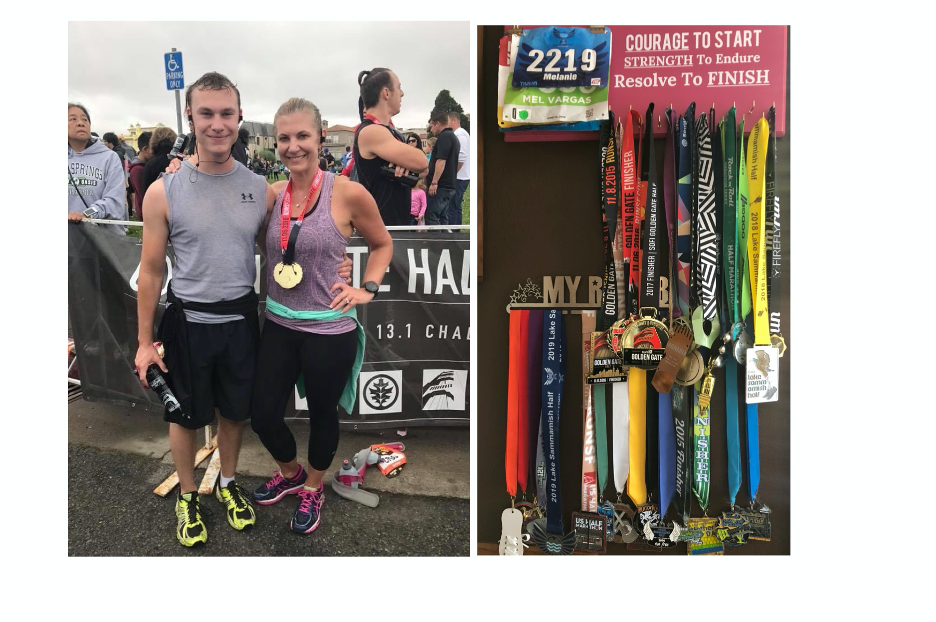
The picture above with my oldest son and I depicts over ten years of running races. Something I started in my 40s. If I can do it, you can do it. I am not an athlete and yet I have run many marathons and half marathons. I even participated in a crazy Ragnar mountain race a couple of years ago. Put something out there that is a stretch goal and just do it. I like to learn, I sign up for classes, for group coaching, or something creative. It’s important to have something to look forward to, to feel accomplished and it feels amazing when we see that we can really do it.

5.    Cultivate Community

This is something I have always done. I have the most amazing group of recovery friends. Early on in my career, I established a network of HR professionals to help guide me and with whom I could share ideas. Now, I am surrounded by coaches who helped me grow as a coach and person for the last two years. Surround yourself with people who have what you want. They will lift you when you are down. Also, reach out to them when you need help or when you are in FEAR. Don’t be afraid to ask for help. This can be a source of strength when you have a setback. People are willing to help you. I would not be here without my community. I would be lost without it. Human beings are not meant to be alone – we need each other.

Resilience is the ability to recover from difficult experiences and setbacks, to adapt, and move forward and sometimes even experience growth. What is great is it can be learned, developed, and honed. If this is not a strength for you, you can learn it and develop it like a muscle. It is like going to the gym. It is hard in the beginning, and we do not like it, but over time it gets easier as we start to build a practice and get more intentional. We are going to have setbacks. The important thing is to not feel shame about them. We are all human. We are in this together.

Melanie is the Founder & CEO of Radical Ignition, Inc. For over two decades, Melanie has spent her career creating pathways for people to be their best and is an experienced leadership coach, people consultant and facilitator. When working with organizations, Melanie draws from her strong business background and over 20 years in senior leadership inside organizations working with executives and leaders at all levels, as well as her experience consulting across hundreds of organizations in her consulting career. You can learn more about Radical Ignition at www.radicalignition.com and reach out at info@radicalignition.com.

Ellevate Event in September

Career Collaborative Coaches, Melanie Vargas, Suzanne Weller and Kristal Roberts couldn’t be more excited about the opportunity to be speaking at #ellevateseattle event on Sept 15. We will be kicking off a speed mentoring event with an interactive dialogue on how to thrive through uncertainty and change. Join us! For registration information, click the link below:

https://www.ellevatenetwork.com/events/11977-virtual-speed-mentoring-thriving-in-times-of-change-seattle-chapter

Leading in Uncertainty: Guiding Teams Through Change and Transition

These are unprecedented times. Change is hard, and yet, we are all living in a world of constant change. We don’t know what we are going to see when we turn on the TV or look on our phones from one moment to the next. The role of leader continues to be more complex. Many of my clients are struggling as they lead dispersed teams, and navigate the fears, feelings and constant uncertainty. Their roles as leaders will remain challenging.

As a leader, how often have you encountered resistance to change? How will you keep employees engaged and handle fear and uncertainty in the workplace? Even small changes can encounter resistance.

Last year, I went through my own life transition when I decided to launch a new business. When the pandemic hit, I spent three weeks in a state of fear, wondering if I should find a job and questioning if it was the right time to launch a business. Once I moved past the fear, I refocused on the future. Creativity and resilience set in, allowing me to see a necessary pivot. William Bridges calls this the Neutral Zone of the transition. It is also a period where tremendous creativity can happen. As I embraced this new transition, my business began to grow. I’ve learned a great deal about leading and driving change inside organizations, but the past year, full of my own transition, has taught me even more.

We have adapted William Bridges’ Managing in Transitions model to include emotions in each zone:

Bridges says that transitions start with an ending. This is the first phase of the transition in the model. Endings are sometimes hard and come with many feelings including denial, anger, shock, anxiety, avoidance and more.

The second phase, the neutral zone, of transition comes after letting go. This is the time between the old reality and sense of identity and the new one. People are creating new processes and learning what their new roles will be. They are in flux and may feel confusion and distress.

We call the Neutral Zone the “messy middle”.


However, this is also a time of creativity and learning. Many of saw this during the Pandemic when businesses were learning to pivot, and there was a tremendous amount of creativity and innovation happening.

New Beginnings involve moving through to new understandings and attitudes. Beginnings are marked by a release of energy in a new direction – they are an expression of a fresh identity. Once we are at the top of the curve, we feel energized. We feel a renewed sense of trust. We have relief.

The goal as leaders is to help first to identify where we are on the curve, and then to identify our team on the curve. Understanding that we all show up differently.

The challenge for leaders is to manage both organizational change and the psychological reorientation that accompany it. Often, leaders focus too much on the change itself and not enough on the human side—the psychological and emotional process people go through. Transition requires helping people let go of the past and move forward into the unknown. Changes may involve workforce reductions, pay cuts, furloughs, or returning to work during COVID. For these shifts to succeed, individuals and organizations need to acknowledge the change and embrace the transition. Often, it’s not the change people ordinarily resist, but the transition process itself.

Letting go of the past is difficult for many employees. This is saying good-bye to the way things used to be; it is concern about what is being lost; concern about what they have to let go of. As we work with organizations, it is not uncommon to hear employees complaining about changes that happened months or even years ago. Holding on to resentments from the past prevents employees from creating the future.

It will be some time before things “return to normal.” Employees may struggle to let go of the past and may feel resentment or anxiety about new ways of working. By helping leaders reduce anxiety, fear, confusion, and resentment, employees are more likely to engage and move forward with resilience. Just as we plan for the mechanics of change, we must also plan for the transitions that come with it.

Here are some steps for transitions that we’ve found work best inside organizations:

Step One: Communicate

  • Listen to the positives and the negatives.
  • Allow people to express themselves.
  • Make sure to communicate context in your messaging.

Step Two: Establish Trust

  • Clarify what is ending for whom.
  • Act as a role model.
  • Identify who may resist and why, and consider how to address it.

Step Three: Engage

  • Engage teams in the process. Allow them to have input either in “what” will change or “how” it will be implemented.
  • Involve key individuals who need to support the changes.

Step Four: Recognize Impact

  • Understand what is ending for whom.
  • Identify impact on people, resources and workloads
  • Assess where there will be any resistance and plan to minimize.

Step Five: Honor the past

  • Don’t skip this important step. Seek to understand the reasons for resistance.
  • Be open to hearing stories and allow space to honor past accomplishments.
  • Recognize the organization’s journey as a story—acknowledging the close of one chapter and the start of another.

Step Six: Accept Different Responses to Change

  • Validate everyone’s individual experiences.
  • Don’t expect others to react as you would.
  • If you thrive in change, be mindful and patient with those who may struggle.
  • Maintain a coaching mindset, fostering a safe environment for openness and honesty.

In times of uncertainty, leaders must rise to the challenge of guiding their teams through both the external and internal aspects of change. By focusing on the both the change and transition, as well as staying aware of their own internal responses to transitions, leaders can support their teams in adapting with resilience. This approach not only fosters smoother transitions but also cultivates a culture of adaptability and empathy in the face of ongoing change.


Melanie is the Founder & CEO of Radical Ignition, a firm dedicated to developing leaders and their teams. Drawing on 30 years of corporate and entrepreneurial experience, she has coached hundreds of executives and teams from six continents across a range of industries, from startups to family-owned businesses, mid-market companies, and Fortune 50 firms.  She works with leaders from brands such as Fresenius Medical Care, CVS Health, Microsoft, Johnson & Johnson, Accenture, Amdocs, Checkpoint, Cedar, and Airtable.

Her coaching philosophy revolves around fostering a thought-provoking and creative partnership with her clients. She believes in empowering clients to unlock their full potential by challenging conventional thinking and encouraging innovative problem-solving.

She is a certified executive coach through the Hudson Institute in Santa Barbara and a Professional Certified Coach (PCC) through the International Coach Federation (ICF). She also serves on the Boards for the Seattle Hudson Coach Community and the ICF Chapter for Washington State.

Pivoting Post-Covid Webinar

Dorsey & Whitney, LLP Webinar Playback

Pivoting Post-Covid: Practical And Legal Considerations To Building Better Companies And Their Leaders

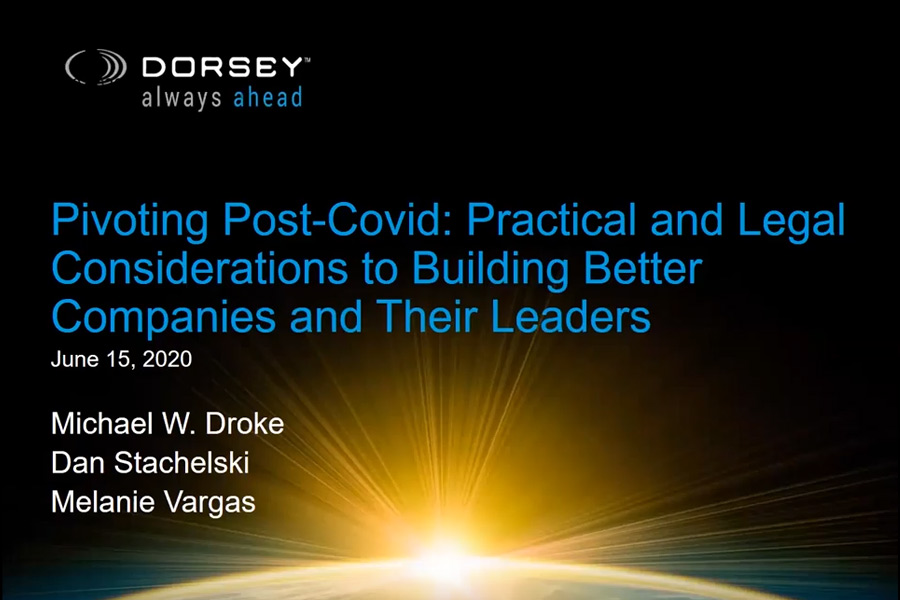
We’re moving from the greatest change period we’ve ever experienced. Some companies pivoted to remote work overnight. Others hit the “pause” button and are now re-launching. How should executives look at their businesses to take maximum advantage of what we’ve learned in the last 3 months? What are the legal and practical implications of changing your business strategy in today’s world? And what can executives learn about themselves in the process? Mike Droke , Partner from Dorsey & Whitney, led an Interactive Dialogue with executive Dan Stachelski and serial start-up executive and business coach Melanie Vargas, on what successful companies are doing to pivot their businesses post-Covid.

Chat bubble icon

Radical Values Exercise

Coaching Tool
Our values can serve as an anchor and source of strength when you are aware of them especially during times of change. Use our tool to discover your core values.

Coaching icon

How I Want to be Coached

Leadership Coaching Tool
Clarify your needs and expectations with direct reports! The more clarity and alignment you have within your working relationships, the better your chances for a productive and enjoyable experience that flourishes.

This field is for validation purposes and should be left unchanged.