Languishing Resurfaced and Why It Feels Heavier Now

A few years ago, Adam Grant gave language to something many of us were quietly experiencing: languishing.

Not depressed.
Not burned out.
Just flat.

When I first heard him describe it, I remember thinking, Yes. That is it. I could finally name the feeling. Life was moving, I was functioning, but something essential felt muted and unsettled.

Languishing lives in the space between suffering and flourishing. You are showing up, checking the boxes, doing what needs to be done, but days blur together. Motivation wanes. Even things you care about take more effort than they should.

Lately, I have noticed that same feeling creeping back in. Only this time, it feels worse. It feels heavier and more entrenched. It also feels harder to shake with a sense of impending doom.

A Quick Revisit: What Languishing Actually Is

In his TED Talk, Adam Grant describes languishing as a state of stagnation and emptiness rather than despair. One of the most important ideas he offers is that languishing is marked by a loss of flow. Flow refers to those moments of deep absorption where time disappears and meaning quietly accumulates.

During the pandemic, flow was disrupted everywhere. Our work blurred into our home life, and our boundaries collapsed. Our days became indistinguishable.

Because languishing is not acute or dramatic, it often went unnamed. Many of us minimized how we were feeling.

I should be grateful
Others have it worse
This will pass

Naming it helped. It helped me then. But naming alone has not been enough now.

Why This Season Feels Harder Now

What is different today is not just the presence of languishing, but what is layered on top of it:

  • Chronic uncertainty rather than a single crisis
  • Accumulated grief rather than acute loss
  • Decision fatigue without meaningful recovery
  • Eroding trust in systems, institutions, and leadership
  • Pressure to be back to normal when nothing actually feels normal

During the Pandemic, there was a shared narrative. Now the stress is diffuse, ongoing, and largely invisible. For leaders especially, there is an added burden. You are expected to step up, execute, and produce results. Meanwhile, you may be quietly questioning your own sense of meaning, impact, and direction.

This is not a motivation problem.
It is not a resilience failure.
And it is not something you fix by trying harder.

The Subtle Shift That Matters Most

If languishing taught us anything, it is this. The opposite of languishing is not happiness. It is agency and this is what it looks like:

  • Having some control over how you spend your energy
  • Experiencing progress, even in small ways
  • Engaging in work that gives something back, not just demands more
  • Reconnecting with what feels alive, not just productive

This is why self-care and self-compassion often falls flat right now. What many of us are craving is not rest alone. It is meaningful friction. Effort that leads somewhere. Challenge that feels purposeful. Conversations that matter.

What Actually Helps and What Does Not

What does not help:

  • More optimization
  • More productivity hacks
  • More pressure to reframe everything positively
  • Gaslighting yourself into gratitude
  • Comparison

What does help:

  • Designing days with one or two moments of absorption
  • Creating small, visible wins instead of chasing big transformations
  • Reclaiming choice, even in constrained environments
  • Naming the fatigue without judging it
  • Letting go of the idea that you should be over this by now
  • Practicing gratitude and acceptance (with realizing that gratitude and difficulty can coexist)

Languishing was never a personal failing. Realizing you are feeling it again is not a failure either. It is a quiet, signal that something in how we are living and working needs to change. During the Pandemic we were overly focused on building resilience and on learning how to bounce back. Today’s season is about reorienting toward meaning, agency, acceptance, adaptability, and aliveness. More importantly, making one intentional choice at a time.

Melanie is Founder & CEO of Radical Ignition, Inc. and draws from 30 years of C-level experience in human resources/organizational development, executive coaching, and consulting experience working across a broad range of industries. She is a self-proclaimed “hyper-achiever in recovery” who thrives in complexity, reinvention, and real talk. Her career has been shaped by startups, shakeups, and a deep personal understanding of adversity. She leans into that lived experience as her lens, and to help leaders confront the hard questions, embrace ambiguity, and find the boldest version of themselves.

To learn more about our consulting, coaching or leadership programs, reach out to us at info@radicalignition.com!

Enough

Looking Back…

This past year was not my best year, and it also was not my worst. That distinction matters.

For those of us who are self employed, it can be tempting to measure a year only by growth, revenue, momentum, or visible wins. When things feel slower, heavier, or less certain, it is easy for scarcity to creep in and start telling a story that something is wrong or that we are falling behind.

There is an almost automatic pull to evaluate, measure, and resolve.

  • What did I accomplish?
  • What didn’t I do?
  • What do I need to change next year?

What kept me grounded this year was staying focused on the here and now. On what was meaningful. On what was steady. On the gratitude that exists even in seasons that challenge us. Abundance is not just about outcomes. It is a mindset rooted in presence, awareness, and perspective.

This year, I chose to invest my energy in meaningful work. I wrote a book. I launched a podcast. Neither led directly to revenue, but both brought me tremendous joy. This reminded me why I do this work in the first place. I stretched myself creatively, deepened my sense of purpose, and reaffirmed that not everything of value can or should be measured immediately.

From that place, reflection becomes possible without turning into self-criticism. As a recovering over achiever and perfectionist, I must be intentional with this practice.

I have never found much wisdom in resolutions. I found myself setting impossible expectations for myself, and then feeling like a failure when it didn’t happen. They often ask us to leap forward without fully understanding where we have been or who we have become along the way.

Instead, this time of year invites something quieter. More honest. More sustainable. I refer setting an intention or choosing a word to focus on for the year. This year, my word was abundance.

As I step into what comes next, I am reminding myself that staying present is a practice, and gratitude is my anchor. When we stay rooted in the present, we stay out of fear, it allows us to make clearer decisions and lead with more humanity. We also resist the urge to measure our worth by outcomes alone.

Especially for those of us building our own businesses, staying present and grateful keeps us connected to why we began in the first place. Not everything needs to be rushed, optimized, or proven right now. Sometimes, the most meaningful work is simply noticing what is already here and allowing that to be enough.

Happy Holidays! Cheers to being enough and having enough! It’s a choice. 


Flex to Influence: The Right Style for the Right Audience

Everyone has a natural communication style. Some are Bullet-Point Thinkers, who lead with the conclusion and summarize key points succinctly. Others are Storyline Thinkers, who prefer to offer background, narrative, and build-up before arriving at the conclusion. Neither is inherently better, but the ability to understand the dynamics in the room, your own style, and flex your style is crucial, especially when communicating with senior leadership.

Storyline Thinkers like to share the story of a situation. They set the stage, explain the origin, and help the listener understand the broader picture before arriving at a recommendation or decision.

Storyline Thinkers:

“Last year at our annual conference we had five speakers. We really tried to offer a diverse set of topics to appeal to a broad audience. We had everything from emotional intelligence to time management to strategic planning. After the event, we received a lot of feedback. Some of it was quite detailed. Attendees appreciated the speaker on emotional intelligence the most, mentioning that her insights were practical and directly applicable to team development. However, some said five speakers made the day feel too packed, and they had trouble absorbing so much information. A few also commented that some content felt redundant across sessions. Based on this input, and after discussing it with the planning committee, we believe it would be best to limit the number of speakers this year. That way, we can go deeper with fewer topics and give people more time to reflect and engage with the content.”

Bullet-Point Thinkers get to the point quickly and back it up with minimal detail as needed.

Bullet-Point Thinkers:

 “We’ve decided to limit the number of speakers at the conference this year based on last year’s feedback.”

As you might expect, we tend to appreciate the communication style that mirrors our own. But here’s the rub:

  • If you’re a Storyline Thinker, Bullet-Point Thinkers may seem abrupt or overly direct.
  • If you’re a Bullet-Point Thinker, Storyline Thinkers may seem long-winded or unclear.

Communicating Up the Chain

While Storyline Thinkers are often encouraged to tighten their messaging for executive audiences and quickly get to the point, it’s equally important for Bullet-Point Thinkers to develop greater awareness of how their style lands. Bullet-Point Thinkers can sometimes come across as abrupt or overly transactional, especially in email or high-stakes interpersonal settings. This can unintentionally create distance or seem dismissive. As leaders grow into more senior executive roles, adapting to a broader range of communication preferences becomes essential. Building empathy and adaptability for Storyline Thinkers, as well as intentionally including more context when needed helps build trust and engagement across teams.

The higher up you go in most organizations, the more you’ll find leaders Bullet-Point Thinkers who prefer direct, concise communication, whether it’s verbal or written. It isn’t necessarily about being abrupt; it’s about efficiency and clarity in their environments with limited time and big decisions to make. You might feel you are a blend of both.

The Adapted Pyramid Principle in Action

The definitive resource on the Pyramid Principle is Barbara Minto’s book, The Pyramid Principle: Logic in Writing and Thinking. This book introduces the concept of structuring communication by starting with the main conclusion, followed by supporting arguments, and then detailed evidence and is a structured communication technique especially effective when addressing executives.

Try this in your next presentation or 1:1:

  1. Start with the answer or recommendation – the bottom line ( this is the top of the pyramid).
  2. List three key points.
  3. Close with a quick summary.
  4. Have data or evidence as a backup to support each point if needed (but do not present it). Your goal is to allow space for questions and invite curiosity.

Pyramid Format in Practice:

Step One: Recommendation/Bottom line:Recommendation/Bottom line:

“We should limit the number of speakers at this year’s conference.”

Step Two: Three Key Points:

    1. “Feedback from last year showed audiences preferred fewer, deeper sessions.”
    2. “Two out of five sessions were poorly rated due to content overlap.”
    3. “The highest-rated session was interactive and focused on application.”

Step Three: Close/Conclusion Summary:

“Streamlining the speaker lineup will allow us to deliver higher-value content and create a more engaging experience, aligned with what our audience values most. “

Step Four: Invite Engagement/Curiosity:

“How can we design sessions that go beyond surface-level sharing and create lasting impact?”

“What criteria should we use to ensure each session adds unique value?”

“How might we build more opportunities for interaction and real-world application into every session?”

“What’s the best way to prioritize speakers and topics so we maximize audience engagement?”

This method appeals to Bullet-Point Thinkers but is accessible to Storyline Thinkers when combined with a brief narrative if asked.

Tips

  • Avoid building up to your point—lead with it.
  • Adapt detail based on audience interest and time.
  • Use clear transitions between points (e.g., “First…”, “Next…”, “Finally…”).
  • Rehearse to keep delivery crisp and confident.
  • Make sure to reflect after your conversation/presentation. It’s always a great idea to ask for your feedback too! Did your message land clearly? Did you feel heard? Adjust your approach based on what worked.

If bullet-point communication is challenging for you, you can practice this in your every day, personal communcaiton. Here is an easy way to remember it:

    1. Headline
    2. Three things
    3. Close

I went to Mexico for four days with my girlfriends last week. We had an incredible time. We ate at  fabulous restaurants, and laid by the pool every day. It was a much needed break from my busy work schedule.”

This activity helps build agility in your communication. One of the key leadership skills for influencing across levels in today’s complex organizations.

Melanie is Founder & CEO of Radical Ignition, Inc. and draws from 30 years of C-level experience in human resources/organizational development, executive coaching, and consulting experience working across a broad range of industries. She is a self-proclaimed “hyper-achiever in recovery” who thrives in complexity, reinvention, and real talk. Her career has been shaped by startups, shakeups, and a deep personal understanding of adversity. She leans into that lived experience as her lens, and to help leaders confront the hard questions, embrace ambiguity, and find the boldest version of themselves.

She works with ambitious executives, founders, and their teams ready to challenge the status quo, not just in their roles and organizations, but in their own thinking, beliefs, habits, assumptions, and leadership style. Whether she’s on a keynote stage or in a coaching session, she brings provocation with purpose. She isn’t engaged with her clients to make them feel comfortable. She is there to make transformation unavoidable.

Melanie is working with leaders from brands such as Fresenius Medical Care, CVS Health, Microsoft, Johnson & Johnson, Accenture, ServiceNow, Cedar, and Airtable. She is a certified executive coach through the Hudson Institute in Santa Barbara, a certified team coach through Clutterbuck International, and a Professional Certified Coach (PCC) through the International Coach Federation (ICF). She is also the President of the Seattle Hudson Coach Community and the Director of Outreach the ICF Chapter for Washington State.

Leading Through Whiplash: Adaptive Leadership

In today’s organizations, leadership isn’t just about setting a vision and executing a plan. It’s about navigating an unpredictable sea of shifting priorities, conflicting values, rising emotional intensity, and, quite frankly, collective burnout.

I call it:

organizational whiplash, the experience of reacting to constant change without time to recalibrate. For many leaders I coach, it feels like managing a team on a spinning carousel: keep it moving, keep smiling, don’t fall off.


This is the new normal. And in our current environment, one kind of leadership stands out as not just relevant but essential.

It’s called adaptive leadership.

What Is Adaptive Leadership?

Ronald Heifetz and Marty Linsky, along with Alexander Grashow, introduced the concept of adaptive leadership in the 1990s and early 2000s, with their book, The Practice of Adaptive Leadership.

It’s based on the idea that some of the most pressing challenges we face don’t have clear solutions and require us to shift mindsets, values, and behaviors rather than apply technical fixes.

Rather than solving problems for people, adaptive leaders create the space for others to face reality, build resilience, and co-create the path forward.

It’s about leading with curiosity and emotional intelligence, especially when the stakes are high and the answers are unclear.

The Center for Creative Leadership conducted a study on the behaviors of adaptable leaders and their white paper focuses on three main components of adaptable leadership: cognitive flexibility, dispositional flexibility, and emotional flexibility.

Why Adaptable Leadership Matters Now

We’re living in an era where traditional leadership approaches, top-down directives, heroic problem-solving, one-size-fits-all strategies are becoming increasingly ineffective.

Today’s senior leaders are grappling with:

  • Organizational whiplash: constant pivots, restructuring, shifting KPIs
  • Rising team sensitivity: amplified emotional responses and lower tolerance for ambiguity
  • Cultural toxicity: erosion of trust, psychological safety, and morale
  • Expectation overload: the pressure to be strategic, decisive, empathetic, inclusive, and inspirational

Why Adaptive Leadership Is Making a Comeback

The need for adaptive leadership isn’t new—but its relevance has skyrocketed. We are witnessing a convergence of forces:

  • Eroding morale and cultural strain
  • Sky-high expectations from boards, customers, and employees
  • Increasing emotional and psychological complexity in teams
  • A deep desire for meaning, authenticity, and transparency in leadership

In Forbes article, Why Adaptive Leadership Is the Leadership Skill We Need Now, Lynda Silsbee, confirms this as she describes shifting markets, advancing, and global events unfolding unpredictably driving the demand for adaptive leadership. Adaptive leadership allows leaders to navigate these complexities with agility, foresight and resilience.

Adaptive Strategies for Senior Leaders and Their Teams

Here are four practical ways to practice adaptive leadership in your organization today:

1. Name the Complexity Out Loud

People don’t need you to pretend everything is under control. In fact, pretending can erode trust. Instead, lead with transparency. Leaders often feel pressure to appear clear, confident, and in control, even when everything around them is shifting. But in adaptive leadership, pretending to have certainty in the face of ambiguity can erode trust faster than admitting you don’t have all the answers.

Naming the complexity out loud isn’t weakness, it’s displaying leadership. It’s saying, “This is messy, and we may not have the perfect solution yet, but we’re going to work through it together.”

As researcher Brené Brown defines it, vulnerability as:

“The emotion we experience during times of uncertainty, risk, and emotional exposure.”

Brené Brown, Daring Greatly


In other words, being vulnerable as a leader means showing up, even when the path is unclear, the stakes are high, and there’s no guarantee of the outcome. When leaders acknowledge complexity instead of masking it, they normalize discomfort, model trustworthiness, and invite collaboration. Especially in moments of change or organizational fatigue, this kind of realness creates the psychological safety teams need to stay engaged and resilient.

You’re saying, “This is complex, and we won’t get it perfect. But we’ll learn together as we go.”  It acknowledges complexity, creates psychological safety, and invites collective problem-solving.

2. Slow Down to Align

In the recent MIT Sloan Management Review, Henrik Saabye and Thomas Borup Kristensen explore Leaders’ Critical Role in Building a Learning Culture. Saabye and Kristensen’s conduct case studies on two large organizations, and their research highlight a key insight: “To become effective learning facilitators, leaders must embrace the counterintuitive approach of going slow to go fast.”

Urgency is tempting, especially under pressure. But speed without alignment leads to confusion and chaos. Take time to pause, clarify purpose, and recalibrate goals before charging ahead. One of the most valuable lessons in today’s complex, evolving leadership is the value of pause.

Ask yourself and your team:

  • What are we solving for now?
  • Has our definition of success changed?
  • Where are we misaligned? 

3. Focus on Building Adaptive Teams in a Learning Culture

Adaptive leadership isn’t a solo act. The goal is to build teams that are self-correcting, self-aware, and capable of navigating complexity together. In today’s environment of rapid technological change, environmental pressures, and evolving customer expectations, a company’s ability to learn and adapt is essential to its survival and long-term success. Still, many leaders underestimate their pivotal role in fostering that learning, particularly when large-scale initiatives require it most.

Another key point made in Saabye and Kristensen’s article is by framing each problem as an opportunity for growth and development, leaders encourage their teams to approach problems with a focus on strengthening long-term skills rather than just resolving the issue at hand.

Ways to do this:

  • Bring curiosity into your leadership
  • Hold regular retrospectives to reflect on what’s working and what’s not
  • Normalize “test-and-learn” approaches instead of seeking perfection
  • Create forums for candid, constructive conversations
  • View problems as learning opportunities

4. Model Emotional Agility

Your team takes emotional cues from you. Adaptive leaders don’t suppress their feelings. They manage them with intention. They recognize stress signals, stay grounded in values, and respond, rather than react.

Watch Susan David’s Emotional Agility Ted Talk:


5. Developing Emotional Agility: Start with Self

In times of change, it’s easy for leaders to focus outward. Leading them to focus on strategy, deliverables, and team dynamics. But adaptive leadership starts inward with self-awareness. Emotional agility isn’t just a personal trait, it’s a leadership muscle. The ability to recognize, regulate, and respond to your own emotions directly impacts how you lead under pressure, navigate conflict, and foster trust.

Leadership is relational, but it begins internally.

The following questions are designed to help you slow down, reflect, and lead from a place of intention rather than reactivity. Consider this your “Self as Coach” moment as an invitation to pause and look inward before leading forward.

One of my personal favorites: “What’s really mine to carry, and what can I co-create with my team?”

Strengthen Emotional Agility

  • What emotions am I feeling right now, and what might be at the crux?
  • Where do I tend to react instead of responding, especially under pressure?
  • What situations bring out defensiveness in me? Why?
  • How do I typically deal with discomfort or uncertainty?

Values & Intentional Action

  • What values do I want to lead from in this situation—even if it’s tough?
  • What would it look like to act from purpose, not protection, right now?
  • What story am I telling myself about this challenge, and is it true?
  • What’s one small action I can take that aligns with who I want to be as a leader? 

 Relational Awareness

  • Am I creating space for others’ emotions, or trying to fix or avoid them?
  • How might my emotional state be affecting my team, spoken or unspoken?
  • Where could curiosity serve me better than control in this conversation?
  • How often do I model emotional agility for my team or just talk about it?

  Learning & Reframing

  • What’s my relationship with failure?
  • What can this situation teach me about myself as a leader?
  • Where am I avoiding growth because it feels uncomfortable or risky?
  • What feedback (direct or indirect) am I hearing, and how am I receiving it?

Bottom Line

Being a leader today means being uncomfortable more often, and more importantly, learning to see that discomfort as a necessary part of growth.

Adaptive leadership isn’t a soft skill, it’s a survival skill.

When you lead adaptively:

  • Morale improves because people feel seen and empowered
  • Sensitivity becomes signal, not noise
  • Toxicity decreases as trust and transparency grow
  • You create a culture where people grow through change not in spite of it

The next time you feel overwhelmed by the pace of change, remember: it’s not a sign you’re doing it wrong. It’s a signal to lead differently.

If you or your team are navigating complexity and want to develop your adaptive capacity, I’d love to connect. I help leaders lead more effectively, and more humanely, through change.

Melanie is Founder & CEO of Radical Ignition, Inc. and draws from 30 years of C-level experience in human resources/organizational development, executive coaching, and consulting experience working across a broad range of industries. She is a self-proclaimed “hyper-achiever in recovery” who thrives in complexity, reinvention, and real talk. Her career has been shaped by startups, shakeups, and a deep personal understanding of adversity. She leans into that lived experience as her lens, and to help leaders confront the hard questions, embrace ambiguity, and find the boldest version of themselves.

She works with ambitious executives, founders, and their teams ready to challenge the status quo, not just in their roles and organizations, but in their own thinking, beliefs, habits, assumptions, and leadership style. Whether she’s on a keynote stage or in a coaching session, she brings provocation with purpose. She isn’t engaged with her clients to make them feel comfortable. She is there make transformation unavoidable.

Melanie is working with leaders from brands such as Fresenius Medical Care, CVS Health, Microsoft, Johnson & Johnson, Accenture, ServiceNow, Cedar, and Airtable. She is a certified executive coach through the Hudson Institute in Santa Barbara, a certified team coach through Clutterbuck International, and a Professional Certified Coach (PCC) through the International Coach Federation (ICF). She is also the President of the Seattle Hudson Coach Community and on the Board for the ICF Chapter for Washington State.

The Lost Art of Thinking and Operating Strategically and How to Get It Back

Are you struggling to think and act strategically?

You are not alone. I’m hearing from my clients that it’s harder than ever to think and operate strategically, and the reality inside today’s organizations confirms it. Tight resources, capacity constraints, and the relentless pace of execution with a sense of urgency leave little room for big-picture thinking.

Yet, strategic leadership isn’t a luxury – it’s a necessity. So how do you push through the noise and carve out space for strategy? Here are some actionable steps and questions to help you start thinking and acting strategically:

✔ Delegate with Intention

If everything is on your plate, nothing gets the depth it deserves. Empower your team to take ownership so you can focus on what moves the needle. This is harder than ever with leaders worrying about their teams being over-resourced.

Ask yourself: What tasks or decisions am I holding onto that someone else could own? Who on my team is ready to take on more responsibility, and how can I support their growth? Am I delegating outcomes or just tasks? What’s stopping me from fully trusting my team to execute?

✔ Focus on the Big Picture

Not everything needs your attention. Identify the 2-3 initiatives that will create the biggest impact and give them the focus they deserve. If you’re delegating and empowering your team, you’re getting out of the weeds and allowing yourself to rise up. You can see more clearly here.

Ask yourself: Am I spending my time on what truly matters, or am I getting pulled into details that don’t move the needle? If I stepped away from my daily tasks for a week, what work would still get done—and what would stall? Where am I allowing urgency to override importance? How can I shift my mindset from “doing” to “leading”?

✔ Create Thinking Space

Being strategic in today’s organizations requires being intentional with protecting your time – whether you are a C-level executive or an emerging leader who desires to grow this skill. Block time on your calendar for deep work and protect it like you would a critical meeting. Strategy requires room to breathe. Protecting your time is essential if you want to have brain capacity for strategic thinking.

Ask yourself: Am I allowing everything to fall on my plate? Where is space for visioning and connecting data to insights? Am I saying no when I need to and only saying yes to the right things?

✔ Strengthen Your Strategic Influence

Strategic thinkers don’t operate in a vacuum. They shape narratives, build alignment, and influence decisions across teams and stakeholders. Yet, the past five years—marked by dispersed teams, remote work, and fragmented communication—have made this skill harder to cultivate. Many leaders have become more transactional, focusing on execution rather than strategic influence.

Ask yourself: Who are my key stakeholders, and do I understand what matters to them? Am I investing in those relationships? How often am I sharing the ‘why’ behind strategic decisions? Am I building trust over time or only engaging when I need something? Where am I relying on authority instead of true influence?

We’ve explored some practical steps to help you reclaim strategic thinking, along with some key questions to challenge your current approach. The goal? To move beyond reactive problem-solving and build a leadership style that prioritizes strategic impact, clarity, and influence in an increasingly complex world.


As an executive coach, speaker, and facilitator, Melanie draws from 30 years of C-level experience in human resources/organizational development, executive coaching, and consulting experience working across a broad range of industries primarily technology startups. She’s worn the hats of both the entrepreneur and the executive, giving her a profound understanding of the challenges and triumphs in these worlds. She has coached hundreds of executives and teams from six continents, from startups to Fortune 50 firms and is a frequently requested speaker on topics such as resilience, change, culture, building confidence, leadership, and empowerment. She works with leaders from brands such as Fresenius Medical Care, CVS Health, Microsoft, Johnson & Johnson, Accenture, ServiceNow, Cedar, and Airtable.

She is a certified executive coach through the Hudson Institute in Santa Barbara, a certified team coach through Clutterbuck International, and a Professional Certified Coach (PCC) through the International Coach Federation (ICF). She is also the President of the Seattle Hudson Coach Community and on the Board for the ICF Chapter for Washington State.

My Top 5 Leadership Lessons from Failures

We often hear about lessons learned from failed companies—issues like not prioritizing market validation or lacking financial discipline. While these are important and true, I’ve been reflecting on whether we take enough time to unpack the leadership lessons and behaviors that contribute to these failures. There is so much more to learn there. Failure, in my experience, is the gateway to success.

Over three decades of working with entrepreneurial companies in human resources, organizational development, consultant, and executive coach, I have witnessed a handful of successful liquidity events—but far more failures. I’ve managed massive reorganizations, layoffs, and shutdowns, all of which have shaped my understanding of what it takes to build high performing leadership teams and successful organizational cultures. Entrepreneurship is inherently risky, but within these challenges lie profound lessons.

Reflecting on my journey, I’ve distilled my insights into five key leadership lessons fundamental to thriving in today’s fast-paced, ever-changing environment.

Failure is your teacher

Having worked with countless high achievers, I’ve realized that failure, while often feared, is an unparalleled teacher. Personally, I’ve learned more from the adversities than from successes. The same applies to organizations: we push hard for wins but often fail to pause and reflect on the losses – it’s often the tragedies that define us. In fact, in times of discomfort, the most learning occurs. Failure fosters resilience and innovation – but only if leaders are willing to pause and reflect.

Unfortunately, I’ve observed that immature leadership teams often dismiss, excuse, or rush past failure. Where is the learning if we don’t pause? Where is the resilience when we ignore failure? Do you take the time to hold a blameless postmortem after a failure on your team? Or do you just point fingers, blame, and move on? Do you stop, pause, and engage in active listening when someone brings a failure on a project to you, or do you immediately start to find fault? Interesting questions to consider.

Blame and shame is an interesting study inside organizations. If I make a mistake, I might feel guilty. If my team fails, it does not define me as a failure (shame/identity). We don’t spend enough time examining our own relationship with shame especially around failure. Brené Brown explains this in her book, Rising Strong: 

Shame is a focus on self, while guilt is a focus on behavior. This is not just semantics. There’s a huge difference between I screwed up (guilt) and I am a screwup (shame). The former is acceptance of our imperfect humanity. The latter is basically an indictment of our very existence.


For example, when a key employee leaves, do you make excuses for their departure, or do you take accountability and reflect on your role in it? Learning from failure requires strong leadership willing to look in the mirror. It fosters trust, drives engagement, and creates a foundation for innovation. Failure is an inherent part of the learning process, and it also fosters resilience. In Forbes Article, 20 Leaders Share Lessons Learned From Business Failure, 15 out 20 leaders mentioned learning from failure as part of their leadership lessons learned.

Slow down to speed up

This timeless lesson is particularly crucial for startups and entrepreneurial ventures. Having worked with so many serial entrepreneurs, I see this as both their greatest superpower and their Achilles heel. Leaders’ urgency to build and launch products sometimes eclipses the need for market validation. According to CB Insights, 35% of startups fail due to a lack of market need—a clear case for slowing down to strategize before moving forward.

I see the emphasis on speed and a sense of urgency as problematic for leaders in larger organizations as well. This drive for speed, urgency, and a relentless focus on results is evident in organizations of all sizes. Leaders often struggle with limited resources, making it challenging to navigate delegation, empowerment, and self-care, which can ultimately lead to burnout for both them and their teams.

Speed can become systemic within the organization, often turning toxic in the culture. It can lead to bad decision-making, misalignment the team, lack of vision, frustrated customers, and disengaged employees. Slowing down doesn’t mean becoming less productive; it means working smarter. Leaders who take time to plan, strategize, and reflect are more likely to make informed decisions. They are better equipped to adapt to the fast-paced changes in their environments.

Slowing down means building infrastructure, behavioral planning, and scalable practices.  Slowing down means taking the time to build alignment in your leadership team and good hygiene around decision making. It means hiring slowly and firing quickly – and yes, this is coming from a senior HR professional. The team that starts the journey may not be the one that finishes it. Taking too long to terminate one senior leader in an early-stage organization can be a terminal decision.

Embrace conflict to foster productive teams

Tough decisions are inevitable. Noam Wasserman’s book, The Founder’s Dilemma, highlights that 65% of high-potential startups fail due to co-founder conflict. I’ve witnessed how unresolved conflicts among co-founders bleed into the leadership team and broader organization, creating misalignment and dysfunction throughout the system.

Leaders and teams often avoid addressing the elephants in the room, sidestepping tough conversations or confronting their own blind spots. This avoidance is frequently rooted in a results-driven mindset—focusing solely on getting things done without building a framework of trust and psychological safety. However, avoiding conflict tends to exacerbate problems. Without trust, people don’t feel safe enough to express their true thoughts or feelings. Healthy, respectful conflict is essential for challenging ideas, fostering innovation, and generating better outcomes. When trust forms the foundation, conflict becomes a constructive force rather than a destructive one. Ironically, by taking the time to develop this framework of trust and psychological safety, we ultimately achieve better results—a concept that has always seemed so straightforward to me!

If leaders avoid difficult conversations, they often lack the skills needed to address performance issues in real time or to reset expectations consistently which leads to productive teams. High performers, in particular, benefit from clear feedback stay engaged continue growing. When leaders lean into difficult conversations to navigate conflict and set boundaries, they foster a culture of accountability. This culture not only addresses immediate challenges but also encourages transparency, trust, and personal development, all of which contribute to long-term success.

In the absence of a culture of accountability, organizations often face a cascade of negative outcomes that can lead to failure. Without accountability, poor performance goes unchecked, creating frustration and resentment among high-performing team members. This lack of recognition for effort and results can lead to disengagement and turnover among top talent, weakening the organization’s overall capability.

Moreover, when leaders fail to set and enforce clear expectations, misalignment becomes systemic. Teams lose focus, resources are misallocated, and goals become increasingly difficult to achieve. This lack of clarity and ownership often fosters a blame-shifting culture, where problems are ignored or passed around rather than solved.

In startups or early-stage companies, the stakes are even higher. Without accountability, leaders may fail to address critical issues, such as product misalignment with market needs or operational inefficiencies, until it’s too late. Toxic behaviors can take root, eroding trust and collaboration. In some cases, this absence of accountability contributes to the erosion of company culture, making it difficult to attract or retain employees who can drive the business forward.

Accountability acts as a foundation for sustainable growth. It ensures that everyone, from individual contributors to senior leaders, is aligned and committed to the organization’s goals. Companies that embrace accountability not only mitigate risks but also position themselves for resilience and long-term success.

Emotional agility during change

Change and uncertainty are constants in organizations, especially during periods of growth or crisis. Companies that prioritize organizational resilience—not just in response to crises but as a proactive strategy—gain a lasting competitive edge. In today’s hybrid and post-pandemic organizations, empathy is perhaps the most important leadership skill as evidenced by this article from the Center by Creative Leadership, The Importance of Empathy in the Workplace. Leaders must recognize and address the emotional side of change. Compassionate leadership, which includes empathy and emotional intelligence, is critical in navigating these challenges.

Susan David, expert on emotional agility and award-winning Harvard Medical School psychologist says the following:

We often lose sight of our shared humanity in the midst of our dogged pursuit of productivity and profit. But success isn’t possible if we’re building upon an unstable foundation. The ability to help others be present with their own emotions is the core to effective teaming and leadership.


Unfortunately, failing companies often prioritize financial performance at the expense of team health. Leaders who neglect the emotional impact of change risk disengagement, resentment, and backlash from their teams . There are people behind products. Emotions and impact behind a message. Too often, the focus is placed on the result or the thing we are trying to change without considering the emotional impact on individuals involved.  Whether due to a lack of emotional literacy or feeling ill-equipped, leaders frequently deliver tough messages without accounting for how their teams might feel. This oversight can lead to significant backlash, as evidenced by negative reviews on Glassdoor or social media following layoffs.

Cultivate culture and values

Successful companies build strong cultures rooted in clearly defined values. Establishing these early on is critical to sustaining growth. Organizations with a values-based culture experience greater alignment, engagement, and ultimately, financial success. Gallup reports that companies prioritizing culture see a 33% increase in revenue.

Founders and CEOs who prioritize culture lay the groundwork for long-term success. Culture and values should be clearly defined and integrated into measurable Objectives and Key Results (OKRs). CEOs must ensure leaders and managers are held accountable for achieving OKRs related to culture and values.

Values should reflect an organization’s identity, not aspirational goals. They should guide hiring, decision-making, and behavior. Involving the team in defining values ensures buy-in and alignment. Values should be behavioral rather than results-based, serving as an anchor during times of change and uncertainty.

Organizations that compromise culture and values for short-term gains often pay the price in the long run. By prioritizing culture and aligning it with strategic goals, companies lay the foundation for sustainable growth.

Final Thoughts

My career has been punctuated by wins and losses, each offering valuable insights into leadership and culture-building. While success is never guaranteed, leaders can significantly improve their odds by letting failure be their teacher, learning to pause, embracing conflict, fostering accountablity, building emotional agility and cultivating culture and values.

Leadership isn’t about perfection; it’s about being intentional, adaptable, and human. By embodying these principles, leaders can build resilient organizations and impactful teams. Entrepreneurship is a journey, and leadership is a continual evolution—but with the right lessons in hand, success is within reach.

 

Melanie is the Founder & CEO of Radical Ignition, bringing 30 years of C-level executive and consulting experience across a broad range of industries. She has coached hundreds of executives and teams across six continents, from startups to Fortune 50 firms, and is a sought-after speaker on topics including resilience, change, culture, confidence, leadership, and empowerment. Melanie has partnered with leaders from top brands such as Fresenius Medical Care, CVS Health, Microsoft, Johnson & Johnson, Google, Accenture, ServiceNow, Cedar, and Airtable.


Dear Younger Self

Dear Younger Self,

Today is the day you are asking for your raise. You are 29. You’ve lived most of your life feeling like you aren’t enough – constantly trying to prove yourself. But today feels different. You’re feeling the weight of your accomplishments. You’re climbing the ladder, you’ve demanded your seat at the table, and now, you’re here. You’ve earned the VP title. But there’s a catch: you’re not being paid like your male peers. No comparable bonus, no matching salary. Today, you’re going to change that.

It stung earlier when you called Mom, hoping for encouragement, and she said it wasn’t a good idea to ask for such a big raise. 30% is a lot, she said. While I was furious with mom then, what I grew to understand later that is well-documented that her era was marked by substantial gender wage disparities far worse than ours, as well as societal norms that discouraged women from negotiating for higher pay. In fact, in 1963, women working full-time earned approximately 59 cents for every dollar earned by men. Also, women made up a smaller percentage of the workforce, and many were concentrated in roles traditionally considered “female jobs,” such as secretarial, teaching, and nursing positions. The pay gap was also significant, and expectations around assertiveness in negotiating pay were culturally geared toward men. She is right about one thing; it’s a bold ask. But here’s the thing—YOU ARE BOLD.

Wow! What a badass you are for not listening to her doubts or critic in your head. Instead, you walked into that room, stood your ground, and asked for what you deserved. Assertiveness has never been something you struggled with, so we can confidently call BS on that societal norm. Let me spoil the ending for you: You got that 30% raise. And guess what? You didn’t get fired, despite the little voice whispering that you might – and the seed that mom planted.

I wish I could spare you some of the discomfort and self-doubt you’re going to face between 28 and 55. I know I can’t stop it, but I can offer you some wisdom to carry with you. First and foremost, hear this: You were never less than. You were always enough. You are enough now, and you always will be.

Being a woman is not a limitation; it is a profound strength. Feeling deeply? That’s power. Vulnerability? That’s power. Emotional depth? That’s power. I know you’ll spend years trying to suppress those emotions, telling yourself it’s necessary to keep your seat at the table because men say it’s weak. Worse, you’ll convince yourself that staying stoic, hardened, and detached is what will prove your worth. But that’s a lie.

The inner critic will be loud—so loud at times you can’t shut it out or it’s stories. Imposter syndrome will creep in, telling you that you don’t belong, that you’re not smart enough, strong enough, or deserving of your success. It will urge you to hide your true self, to adapt and shrink to fit spaces that weren’t built with you in mind.  It will convince you that you must work harder, and longer, do more, take on more.  It will seduce you into believing that you must say yes to everything that comes your way – sacrificing your relationships and family at times. You’ll swing the pendulum so far to the other side, trying to be someone you’re not, just to silence those voices.

But here’s the secret: You don’t have to fight so hard to prove your worth. You already have it. What would it feel like to challenge less and feel more? What would it look like to lean into your authenticity and show up as your full self—emotions, intuition, and all?

Imagine stepping into a room and owning it, not because you’ve fought tooth and nail to belong but because you know you already do. Your authenticity is not a liability; it’s your superpower. Your ability to lead with empathy, to connect, to inspire, and to uplift others is what makes you extraordinary.

So, dear younger self, march into that office today and ask for what you deserve. Know that every uncomfortable step you take now is paving the way for the woman you’ll become—the woman writing this letter, who knows her worth and stands firmly in it.

With love and gratitude,

Your 55-Year-Old Self

Melanie is the Founder & CEO of Radical Ignition and draws on 30 years C-level executive experience and consulting experience working across a broad range of industries. She has coached hundreds of executives and teams from six continents, from startups to Fortune 50 firms and is a frequently requested speaker on topics such as resilience, change, culture, building confidence, leadership, and empowerment.  She works with leaders from brands such as Fresenius Medical Care, CVS Health, Microsoft, Johnson & Johnson, Accenture, ServiceNow, Cedar, and Airtable.

New Beginnings and Embracing Change

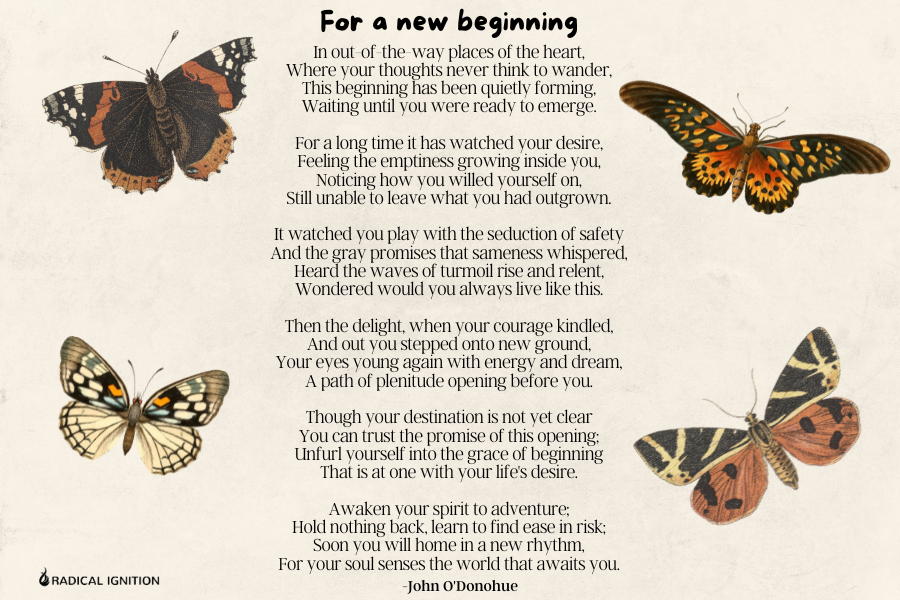
I first heard John O’Donohue’s For a New Beginning when I was attending the Hudson Institute of Santa Barbara going through my executive coaching certification, and it has held a special place in my heart. O’Donohue beautifully captures the essence of transition — the quiet, transformative moments that often weave around outward change.

As we embrace the New Year, O’Donohue’s poem offers timeless wisdom on growth and renewal—two vital themes for navigating change and uncertainty. Reflecting on my work with leaders and organizations amidst transformation, I see this as an opportunity to explore five key themes inspired by his words.

1. The Call to Change

“In out-of-the-way places of the heart,
Where your thoughts never think to wander,
This beginning has been quietly forming,
Waiting until you were ready to emerge.”


We are seeing so much change in the world and inside organizations. Change is constant. Yet, change within us often begins in silence, in the unnoticed spaces of our inner world. As we reflect on the past year, we may recognize the subtle shifts that have been preparing us for something new. It’s often in these uncomfortable moments, there is the most learning. It’s the tragedies in our lives that define us. They are the fence posts on which the rest of our lives hang. The world is a beautiful, resilient place. In coaching, we explore these hidden desires with our clients and allow them to surface, nurturing readiness for the next steps.

2. Letting Go of the Familiar

“For a long time it has watched your desire,
Feeling the emptiness growing inside you,
Noticing how you willed yourself on,
Still unable to leave what you had outgrown.”


The New Year invites us to acknowledge what we’ve outgrown. Whether it’s habits, roles, or mindsets, the allure of safety and sameness can hold us back. Sometimes it keeps us stuck – stuck in toxic cultures, companies or with terrible managers. How can we start to shift habitual behaviroal patterns that are not serving us anymore? How can we reframe negative thoughts or beliefs that no longer serving us? These familiar patters impede our growth. In the coaching process, we explore this tension, helping our clients navigate the delicate balance between honoring their past and embracing their future.

3. Cultivating Courage

“Then the delight, when your courage kindled,
And out you stepped onto new ground,
Your eyes young again with energy and dream,
A path of plenitude opening before you.”


Every beginning requires courage. In moments of uncertainty, it’s natural to hesitate. Yet, as O’Donohue reminds us, stepping onto new ground brings renewed vitality and possibility. Leaders often face the challenge of stepping into uncharted territory—whether it’s taking on a new role, driving transformation in their organization, or redefining their leadership style. The New Year is an ideal time to reconnect with dreams that may have been dormant and to chart a course for what’s next. In coaching, we focus on fostering this courage by identifying core strengths, reframing limiting beliefs, and cultivating the mindset necessary to embrace growth. This work helps our clients approach new opportunities with clarity and confidence, rekindling their vision and energy for the road ahead.

4. Trusting the Unknown

“Though your destination is not yet clear
You can trust the promise of this opening;
Unfurl yourself into the grace of beginning
That is at one with your life’s desire.”


Trusting the unknown can feel counterintuitive. We are conditioned within our organizations to plan meticulously, control outcomes, and anticipate risks. Yet, transitions—whether they involve stepping into a new role, launching an initiative, or navigating industry disruption—demand a different skill: the ability to embrace ambiguity. This is an increasingly more important skill for leaders in today’s organizations.

In our coaching, we work with our clients to reframe uncertainty as opportunity. Instead of focusing on what’s unclear or beyond control, we work on developing trust in their ability to adapt, embrace, and thrive. This trust comes from self-awareness, clarity of values, and confidence in the vision they’re striving toward.

Trusting the unknown also requires letting go of the need for perfection or certainty and leaning into curiosity. What can be learned from this moment? How might unexpected outcomes lead to innovation or growth? In coaching, we explore these questions, encouraging clients to see ambiguity not as a threat but as fertile ground for creativity, bold decision-making, and transformative change.

By cultivating this mindset, leaders not only navigate the unknown more effectively but also model courage and resilience for their teams, fostering an environment where others feel empowered to take risks, innovate, and grow alongside them.

5. Finding Rhythm in Change

“Awaken your spirit to adventure;
Hold nothing back, learn to find ease in risk;
Soon you will home in a new rhythm,
For your soul senses the world that awaits you.”


As the New Year unfolds, we are invited to approach life with a spirit of adventure, embracing risk and growth as natural companions. Change can feel scary at first, but with time, a new rhythm emerges. We can accept it as a way of life – it will help us to move through it and move our teams through it. Coaching supports this process, helping individuals align their actions with their aspirations. Coaching helps leaders identify strategies to find equilibrium during change and transition, whether they’re scaling operations, managing cultural shifts, or facing market uncertainties. By developing emotional agility and learning to lean into calculated risks, leaders can create an environment of trust and adaptability for themselves and their teams.

For a New Beginning reminds us that the New Year is not just a change in the calendar but an invitation to awaken, to step boldly into what’s next, and to trust the process of becoming. As we navigate transitions, let this poem be a guide and a reminder that even in uncertainty, the promise of a fulfilling path lies ahead. Don’t be tempted to rush through times of uncertainty and discomfort or dismiss emotions. Instead, embrace and sit still with those feelings, which may be exactly what is needed. It is within the discomfort that the most profound learning often begins.


Melanie brings a dynamic journey that blends the experience of working across many organizations from startups to Fortune 50 in various industries with the strategic wisdom of three decades in C-level roles in Organizational Development and HR. Her mission is to ignite her clients’ leadership prowess and help them unleash their full potential. She’s worn the hats of both the entrepreneur and the executive, giving her a profound understanding of the challenges and triumphs in these worlds. She understands the urgency, agility, and innovation needed to thrive in this ecosystem.

She is coaching leaders and their teams in organizations such as CVS Health, Microsoft, Fresenius Medical Care, ServiceNow, Johnson & Johnson, Amdocs, Accenture, Amdocs, Checkpoint, Centrical, and Cedar.

Channeling our Inner Melanie Vargas – Mining for Mental Health Awareness Gems

Join us on this Lifting Leaders podcast with the amazing Kristal Roberts, PCC and Tricia Rhine, MSSL, PCC. as Melanie shares her thoughts on this special topic that has touched her family deeply. We’ll explore mental health at work and the critical role that leaders need to play.

https://www.podcasts.com/lifting-leaders/episode/channeling-our-inner-melanie-vargas-mining-for-mental-health-awareness-gems

Coffee House Podcast: Melanie Vargas – Radical Ignition / Career Disruption / Getting to the Root of the Problem

Join us for this Podcast where Melanie shares the history of when she first worked with a coach, which inspired her to become one herself. Thank you Gary P. Nowak for for having us as a guest on Coffee House Podcast. It was a fantastic conversation, and so much fun! We forward to more collaborations and conversations in the future!


Chat bubble icon

Radical Values Exercise

Coaching Tool
Our values can serve as an anchor and source of strength when you are aware of them especially during times of change. Use our tool to discover your core values.

Coaching icon

How I Want to be Coached

Leadership Coaching Tool
Clarify your needs and expectations with direct reports! The more clarity and alignment you have within your working relationships, the better your chances for a productive and enjoyable experience that flourishes.

This field is for validation purposes and should be left unchanged.